2026 Best International Customs Broker Services for Global Trade Success?
In today's interconnected world, businesses increasingly rely on international customs brokers to navigate the complexities of global trade. The global logistics industry is expected to reach $12 trillion by 2027, stressing the importance of effective customs services. An experienced customs broker is crucial for preventing costly delays and managing compliance.
Many companies underestimate the challenges of international shipping. A single error in documentation can lead to shipment holds, fines, or customs inspections. Industry reports indicate that nearly 30% of shipments face delays due to customs issues. Partnering with a reliable international customs broker can significantly reduce these risks.
Understanding trade regulations is vital. Brokers provide expertise that helps businesses comply with local and international laws. However, not all brokers offer the same level of service. It is essential to evaluate different options carefully. The right choice can mean the difference between seamless operations and costly setbacks. Investing time in selecting a qualified broker is as important as the trade itself.

Overview of International Customs Broker Services in 2026
In 2026, international customs broker services are integral for businesses engaged in global trade.
These services facilitate the complex navigation of import and export regulations, ensuring compliance and smooth transactions.
Many companies rely on experienced customs brokers to avoid costly delays. Effective brokers understand local laws and trade agreements,
thus protecting clients from potential penalties.
Understanding the different types of customs broker services can be beneficial.
Some brokers focus on specific industries or geographic areas. Others offer comprehensive services, including
tariff classification and duty drawback assistance.
This specialization can impact efficiency. The best brokers leverage technology for real-time updates on regulatory changes, ensuring that their clients remain informed and compliant.
Tip: Always vet potential customs brokers for their credentials. Look for certifications or recommendations from trade associations.
Mistakes can happen, even with the best expertise. There are instances when documents may be submitted incorrectly, leading to shipment delays.
Regularly reviewing processes can help identify weaknesses and enhance overall performance.
Tip: Continuous training for staff on customs regulations can improve compliance.
Encourage team members to attend workshops or webinars related to trade laws.
Key Factors for Selecting a Customs Broker for Global Trade
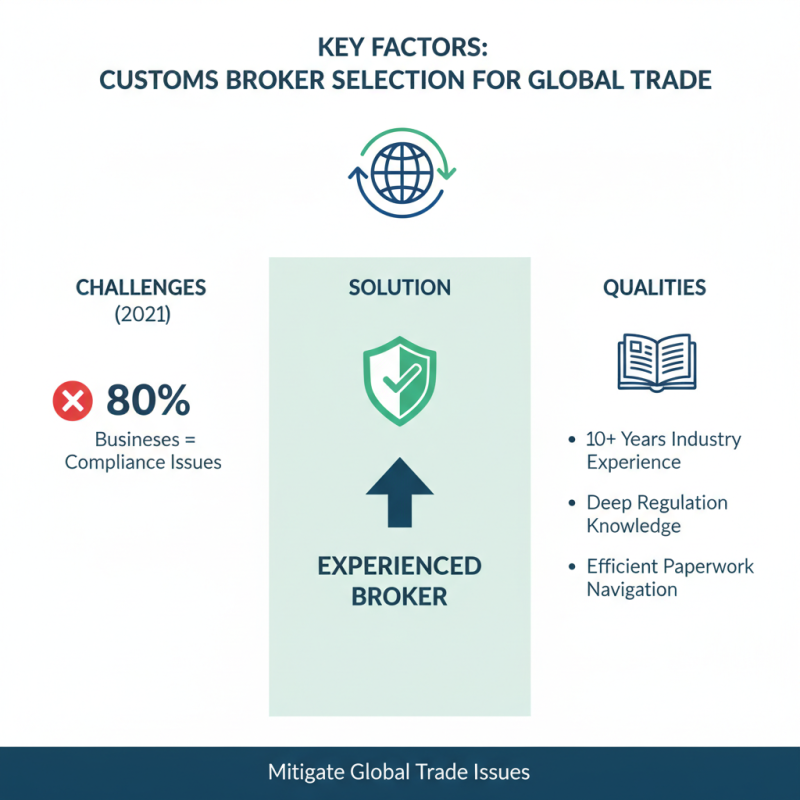
Selecting the right customs broker is crucial for global trade success. In 2021, 80% of businesses reported challenges with customs compliance. Finding a broker with extensive experience can mitigate these issues. Look for brokers that have been in the industry for over a decade. They understand regulations better and can navigate complex paperwork efficiently.
Experience matters, but so does technology. A customs broker using up-to-date software can speed up the clearance process. According to a 2023 report by the International Trade Association, companies utilizing tech-savvy brokers experienced a 30% decrease in shipment delays. Brokers should also offer transparent tracking systems. It builds trust and helps manage expectations.
Communication is another key factor. Your broker should provide timely updates on regulations and tariffs. In a rapidly changing global environment, staying informed is vital. An effective customs broker not only clears shipments but also educates clients. Ultimately, partnering with the right broker can save costs and improve supply chain efficiency. Reflect on your current broker’s performance and explore alternatives if their service lacks these essential elements.
Top Customs Brokerage Firms for International Trade Success
Effective customs brokerage is crucial for
international trade success. As global markets expand, navigating customs regulations can be complex.
The right customs brokerage firm can simplify these processes and ensure compliance
with local laws. This collaboration can save time and resources, enabling businesses to focus on growth.
When selecting a customs broker, consider their experience and track record.
A strong reputation can indicate reliability. Look for brokers who
understand different regulatory environments. Specific expertise in handling various goods can also prove beneficial.
Tips: Always ask for references. Engaging with previous
clients can provide insights into a broker's capabilities. Additionally, assess their technology use.
A broker who leverages modern tools can enhance efficiency. Remember,
the right partner can greatly impact your success in global trade.
Emerging Trends in Customs Brokerage Services for 2026
In 2026, customs brokerage services are evolving rapidly. Automation and artificial intelligence play a vital role in streamlining processes. According to a recent report from the International Federation of Customs Brokers, about 70% of customs operations will integrate AI to enhance operational efficiency. Real-time data sharing is another emerging trend, enabling faster decision-making and reducing delays.
The demand for qualified customs brokers is increasing. As global trade continues to expand, complex regulations challenge businesses. A survey indicated that 65% of companies find compliance to be their greatest obstacle. This complexity drives entrepreneurial spirit in the customs sector, leading to innovative solutions. For example, blockchain technology is gaining traction, promising improved transparency and traceability in shipping.
The skills required for customs brokerage are also changing. Brokers must now possess not only regulatory knowledge but also tech-savvy capabilities. Professionals need ongoing education to stay updated with international laws and technological advancements. Unfortunately, many brokers struggle to keep up, potentially risking compliance and efficiency. Adapting to these changes is crucial for success in the increasingly competitive landscape of 2026.
2026 Best International Customs Broker Services for Global Trade Success
This chart illustrates the emerging trends in customs brokerage services for 2026, highlighting key performance indicators such as efficiency, technology integration, customer satisfaction, and service diversity.
Regulatory Challenges and Solutions in International Customs Brokerage
In the realm of international customs brokerage, regulatory challenges can be daunting. Complex customs regulations often vary from country to country. Misinterpretations can lead to delays and increased costs. Brokers must stay updated with evolving laws. This requires ongoing training and effective communication with relevant authorities.
Finding solutions to these challenges is crucial for success. One effective approach is leveraging technology. Digital tools can streamline the documentation process. They can also help in tracking shipments and ensuring compliance in real-time. However, technology can’t replace human expertise. A skilled broker adds value through experience and problem-solving skills.
Collaboration with customs officials can also facilitate smoother transactions. Building good relationships can yield benefits like expedited clearances. Nevertheless, the human element introduces variability. Each broker may have differing levels of experience and motivation. It is essential to select a broker who understands your specific trade needs. Careful assessment is necessary to ensure reliable brokerage services.
2026 Best International Customs Broker Services for Global Trade Success
| Service Type |
Key Features |
Countries Covered |
Regulatory Challenges |
Solutions Provided |
| Customs Brokerage |
Fast clearance, documentation management |
USA, Canada, EU |
Complex tariff classifications |
Expert tariff consulting |
| Freight Forwarding |
Door-to-door service, flexible scheduling |
Asia, Africa, Australia |
Customs delays due to regulations |
Real-time tracking and updates |
| Import/Export Consulting |
Market analysis, compliance strategy |
Global |
Understanding local regulations |
Dedicated regulatory advisors |
| Tariff Classification |
Harmonized System codes determination |
Multiple countries |
Misclassification risks |
Accurate classification support |