Why Choose a Manual Linear Stage for Precision Movement?
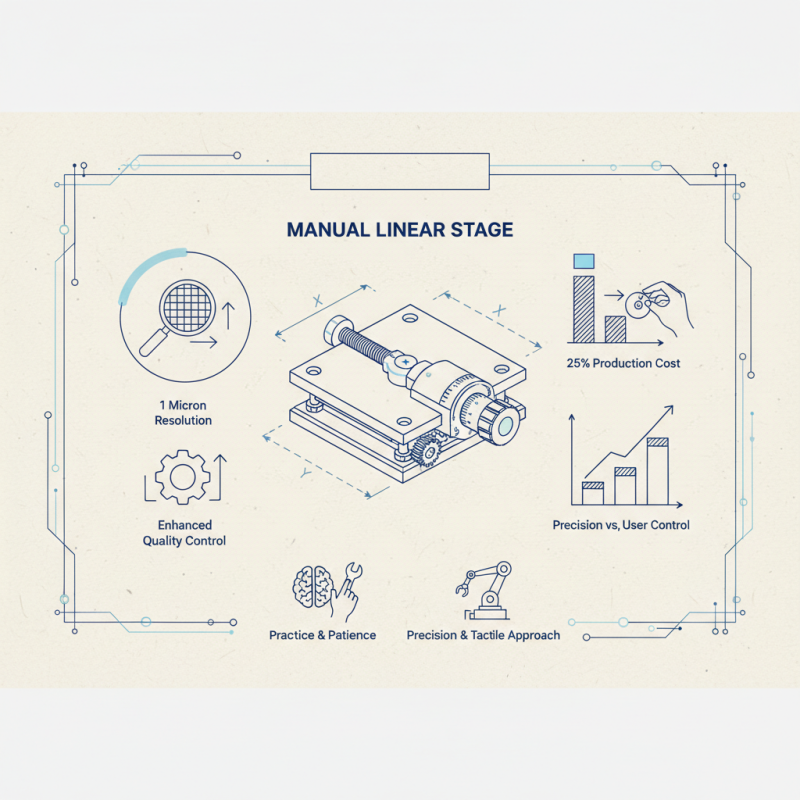
Choosing a Manual Linear Stage for precision movement offers significant advantages in various industrial applications. Recent reports show that precision equipment contributes up to 25% of overall production costs in manufacturing. A Manual Linear Stage allows for accurate adjustments, enhancing quality control.
In laboratories and production lines, the need for precision is essential. Manual Linear Stages are designed for fine-tuning movements, allowing users to achieve resolutions of up to 1 micron. This level of detail can dramatically improve outcomes in fields like optics and material testing. However, it's important to note that relying solely on manual adjustments might introduce human error.
Despite the advantages, some might overlook the benefits of using Manual Linear Stages. They require practice and patience to master. Machinery operates with programmed precision, yet manual stages demand a tactile approach. Finding the right balance between precision and user control is a continuous journey. This combination makes Manual Linear Stages an invaluable tool in precision movement applications.
Benefits of Manual Linear Stages in Precision Applications
Manual linear stages are essential in precision applications where accuracy and control are vital. They offer several benefits that stand out in various fields. These stages allow for fine adjustments, perfect for tasks requiring meticulous movements. Users can easily make micro-adjustments by hand, ensuring precise positioning. This level of control can be crucial when working with sensitive instruments in laboratories or manufacturing.
Additionally, manual linear stages are often more affordable than automated options. They require less maintenance and fewer complex components. This simplicity can be advantageous for organizations on a tight budget. However, users must acknowledge the physical effort involved. It may not be feasible for routine tasks that demand high efficiency. Striking a balance between manual control and efficiency is essential for productivity.
Moreover, while manual stages can be incredibly precise, human factors play a role. Operator skill significantly impacts the final outcome. A slight tremor or distraction could lead to errors in positioning. It’s important to reflect on these limitations. Are there practices to enhance focus and reduce fatigue? Exploring these questions can lead to better results in precision applications.
Key Features of Manual Linear Stages for Accurate Movement Control
Manual linear stages offer precise movement control that is vital in various applications. These stages utilize mechanical components, giving users a tactile feel that enhances accuracy. The ability to make incremental adjustments allows for fine-tuning that is often necessary in research environments. According to industry reports, manual linear stages can achieve positioning accuracies of up to 1 micron in laboratory settings.
One key feature of manual linear stages is their simplicity. Users can operate these devices without needing complex software or electrical interfaces. This can be a double-edged sword. While ease of use is beneficial, reliance on manual operation can lead to human error. Reports indicate that despite their simplicity, operator training is crucial. Poor technique can reduce the overall effectiveness of the stage.
Another important aspect is the construction material. High-quality materials ensure durability and stability. However, heavy materials can limit portability. Some stages, while robust, may not suit all environments. Industry studies suggest that the ideal choice balances weight and strength. Additionally, the absence of automation can be a drawback in high-throughput scenarios. Ultimately, careful consideration of these features can enhance performance and reliability.
Comparison of Manual vs. Motorized Linear Stages in Industry Use
In industrial applications, choosing between manual and motorized linear stages can be crucial. Manual stages offer simplicity. They require no power supply, reducing complexity. Users can easily adjust positioning based on tactile feedback. However, this can lead to inconsistencies. Human error may impact precision. The need for careful hand movements can deter some users.
On the other hand, motorized stages allow for programmed movements. They excel in repetitive tasks. This automation can significantly enhance productivity. Yet, these systems come with a learning curve. Operators may need training to utilize advanced features effectively. Additionally, the reliance on software presents risks. Technical malfunctions can disrupt workflow.
Choosing the right stage ultimately depends on specific needs. Manual stages may suit dedicated applications needing fine adjustments. Motorized options are better for high-volume tasks. Striking the right balance is vital. Understanding the strengths and weaknesses of each type helps in making a more informed decision.
Application Scenarios for Manual Linear Stages in Research and Development
Manual linear stages are invaluable tools in research and development. They excel in applications like microscopy, laser positioning, and precision assembly. These stages allow for fine adjustments, which are critical when exact positioning is required. According to a recent industry report, over 75% of research labs rely on manual linear stages for their experiments involving sensitive materials.
In microscopy, for instance, precise movement can enhance imaging quality. When adjusting the focal plane, even minor shifts can lead to significant differences in results. Each increment can be just micrometers apart. Manual stages provide tactile feedback, allowing users to feel the adjustments. This is essential in delicate operations where electronic systems might contribute to instability.
Tips: Always consider the load capacity of a linear stage. Overloading can lead to inaccuracies and potential damage. Regularly check the alignment as misalignment can result in uneven movement, affecting overall performance.
In laser applications, precise positioning of the beam is critical. Any deviation can result in loss of efficiency or effectiveness. Manual linear stages enable users to make real-time adjustments based on visual feedback. However, proficiency comes with practice. Errors can occur, particularly in high-stress scenarios where time is limited. Attention to detail is essential for optimal results.
Performance Metrics: Load Capacity and Resolution in Linear Stages
When choosing a manual linear stage, two key performance metrics stand out: load capacity and resolution. Load capacity determines how much weight a stage can support. A higher load capacity can handle heavy equipment. This fact often seems straightforward, but it is crucial to match the load with the application. A mismatch can lead to performance issues or damage.
Resolution is another vital metric. It refers to the smallest incremental movement that can be achieved. A higher resolution allows for finer adjustments. This precision is essential in applications like microscopy and laser alignment. However, many users underestimate the impact of resolution. They may find that achieving the desired outcomes requires more attention to this detail.
In practice, balancing load capacity and resolution can be tricky. For instance, a stage may boast a high load capacity but compromise resolution. Conversely, opting for high resolution may limit the load it can bear. Evaluating these factors is not always straightforward. Users should reflect on their specific needs and the implications of their choices. Finding the right setup is often a journey of trial and error. The nuances involved can lead to insightful learning experiences.
